About · Research
Research vision.
I am a PhD candidate under the joint supervision of Prof. Elliott Ash and Prof. Mrinmaya Sachan at ETH Zurich, and Prof. Markus Leippold at University of Zurich. I divide my time equally between both institutions.
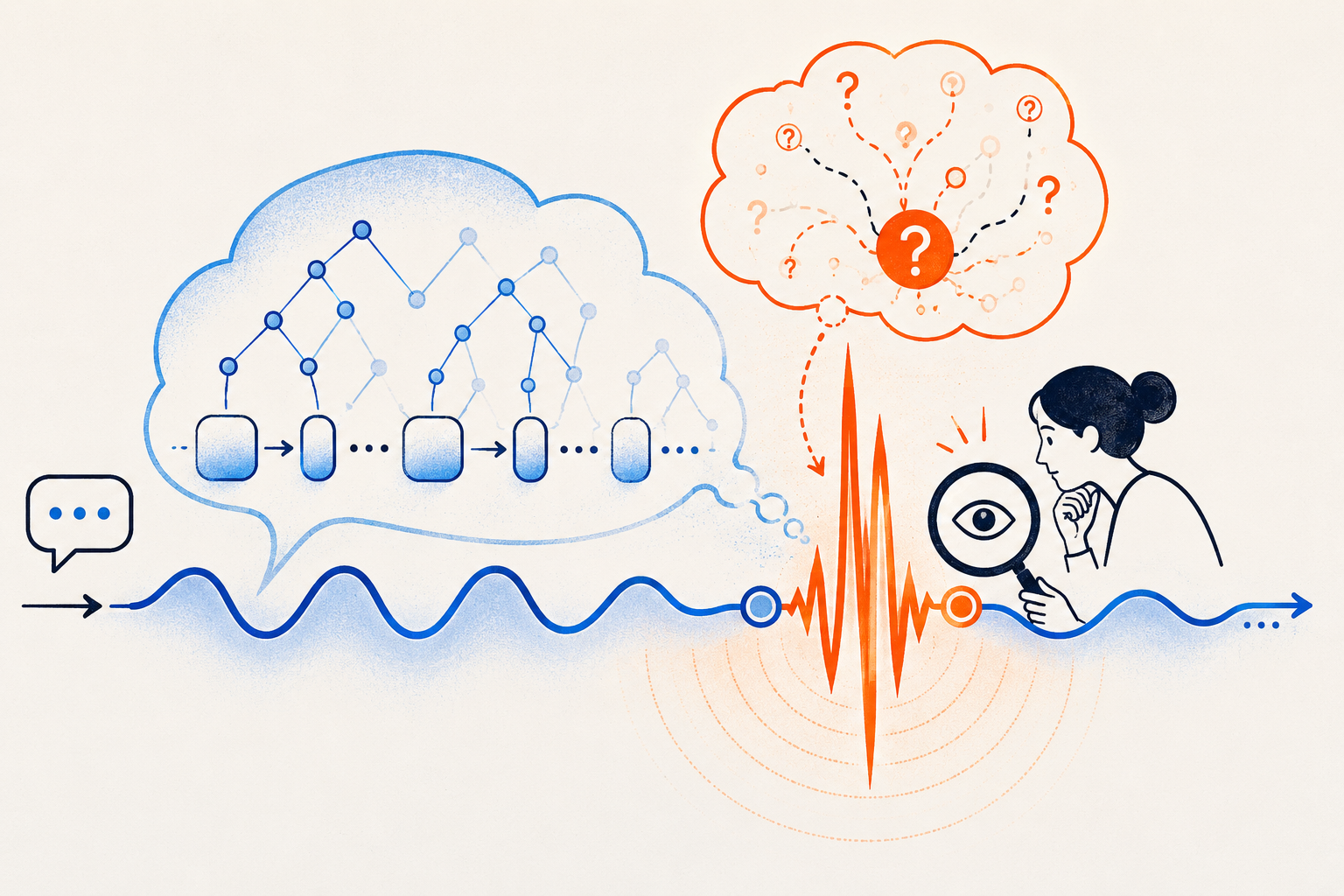
People instruct agents and write rubrics in natural language, which leaves a fuzzy and unverifiable part whose ground truth is a distribution of human judgments rather than a point answer. I believe that getting this part right, so that a model matches the distribution of human judgments and knows how well it knows that distribution, is key to teaching AI taste, preventing reward hacking, and aligning AI beyond the verifiable.
My PhD work covers two foundations: judgment with fuzzy criteria, evaluating and improving how LLMs handle human disagreement and building human-AI collaborative annotation tools, and uncertainty quantification that reads a model's beliefs about its own answers from its hidden states.
Selected work
Research highlights.
Evaluating and improving how LLMs handle fuzzy criteria
LLM judges inherit the fuzzy part of a rubric, so I test models against distributions of human judgments rather than a majority label. Can Reasoning Help LLMs Capture Human Annotator Disagreement? finds that models collapse legitimate disagreement into one overconfident answer, and that RLVR-style reasoning training makes this worse. DIRAS learns calibrated judgments under nuanced natural-language criteria and distills them into small models.
Human-AI collaborative annotation tools
Judgment under fuzzy criteria needs people in the loop, and the tool decides where their judgment goes. Co-DETECT lets an expert refine a rough codebook: it uses annotation uncertainty to surface edge cases the codebook does not cover, induces generalizable rules for them, and leaves the expert in charge of what enters the codebook. AFaCTA calibrates LLM annotators on a small human set and routes items between people and models, so validated labels scale into benchmarks.
Reading a model's beliefs from its hidden states
The spread of human judgments is irreducible. A model's uncertainty about that spread is not, and it is what a clarification question can resolve. ReProbe reads a frozen LLM's internal states to estimate the credibility of each reasoning step, enabling efficient verification and test-time search without a large process reward model. BELT reads a model's beliefs about its current and future answer from the same hidden states and fits a small stopping policy on them, so one probe serves different accuracy-cost trade-offs and transfers from math to coding and agentic tasks.
Projects · Talks · Service
Community collaboration and services.
Collaboration
Apertus: Democratizing Open and Compliant LLMs
Community collaboration on democratizing open and compliant LLMs for global language environments, with contributions to trustworthiness post-training.
Technical report →Collaboration
When AI Benchmarks Plateau
Community collaboration accepted to ICML 2026 on benchmark saturation and how plateauing scores affect evaluation practice.
ICML 2026 →Workshop
ClimateNLP 2024 / 2025 / 2026
Co-organizing the ClimateNLP workshop series: ACL 2024 in Bangkok, ACL 2025 in Vienna, and EMNLP 2026 in Budapest.
Invited Talk
Keynote at the AI4Law Workshop, ICML 2026
Keynote speech at the AI4Law workshop at ICML 2026 on uncertainty-aware LLM reasoning for legal tasks.
Slides →Publications
Selected research
Distributional alignment to fuzzy human criteria, human-AI collaborative annotation tools, and uncertainty quantification.
ReProbe: Efficient Test-Time Scaling of Multi-Step Reasoning by Probing Internal States of Large Language Models
Reads internal uncertainty signals from a frozen LLM to estimate reasoning-step credibility, enabling efficient step verification and test-time search without a separate large process reward model.
Same Beliefs, Different Policies: Learning Reusable Representations for Early Stopping in LLM Reasoning
Reads a frozen model's beliefs about its current and future answer from hidden states and fits a small stopping policy on them, cutting reasoning tokens by 41–51% at equal accuracy and transferring from math to coding and agentic tasks.
Trace2Skill: Distill Trajectory-Local Lessons into Transferable Agent Skills
Consolidates lessons from successful and failed agent executions into reusable natural-language skills that transfer across tasks and models without parameter updates.
Can Reasoning Help Large Language Models Capture Human Annotator Disagreement?
Scores LLMs against distributions of human annotator judgments: models collapse legitimate disagreement into one overconfident answer, and RLVR-style reasoning training makes this worse.
DIRAS: Efficient LLM Annotation of Document Relevance for Retrieval Augmented Generation
Learns calibrated relevance judgments under nuanced natural-language criteria, then distills them into smaller models for efficient deployment.
Co-DETECT: Collaborative Discovery of Edge Cases in Text Classification
Uses annotation uncertainty to surface edge cases a coarse codebook does not cover, then induces generalizable rules that the expert reviews and adds to the codebook.
Research Mentorship & Supervision
Skill-RM: Unifying Heterogeneous Evaluation Criteria via Agent Skill
Research mentorship at Qwen · Tao Chen
GD2PO: Mitigating Multi-Reward Conflicts via Group-Dynamic reward-Decoupled Policy Optimization
Research mentorship at Qwen · Haotian Liu
Understanding Failures in LLM Reasoning by Learning Structured Representations of Chain-of-Thought
Research mentee · Tommaso Felice Banfi
Unlocking LLM Legal Reasoning with IRAC-Constrained Chain-of-Thought
Master student · Adam Rahmoun
Full publication list
Education
Academic path
PhD @ ETH D-GESS
ETH Zürich & University of Zürich
MSc in Data Science & Machine Learning
University College London
BEng in Computer Science
University of Hong Kong